
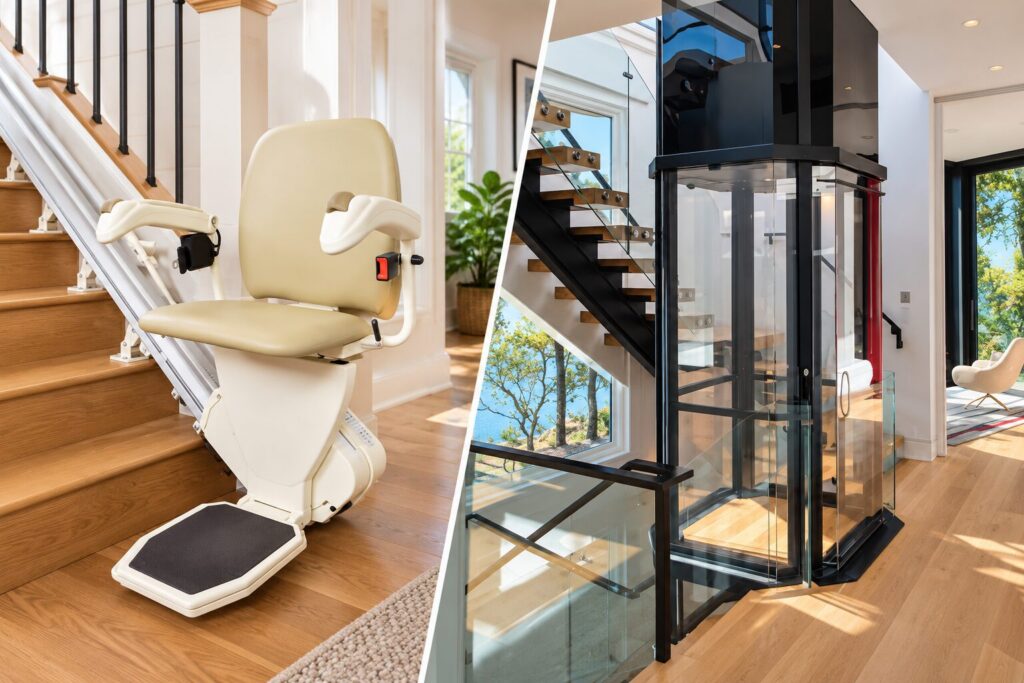
When several generations share a home, the same staircase can mean different things to different people. One family member may use it effortlessly, another may find it tiring, and someone else may need wheelchair access between floors.
Choosing a lift for a multigenerational home starts with understanding those different needs. The goal is to make important spaces accessible while choosing equipment that works with the household’s routines.
For families comparing stair lifts and home elevators in Wisconsin, here are the questions that can help guide the decision.
Who Will Use the Lift?
Begin with the people who will use the equipment regularly.
A stair lift transports a seated passenger along a staircase. It may be appropriate for a family member who has difficulty climbing steps but can transfer to and from the seat.
A home elevator transports passengers vertically between floors. Depending on the model and capacity, it may accommodate a wheelchair or another passenger.
Do not assume that every elevator is wheelchair-accessible. Confirm usable cab dimensions, doorway clearance, weight capacity, and space to enter and exit with the actual mobility device.
Which Parts of the Home Need to Be Accessible?
Make a list of the spaces each person needs to reach: bedrooms, bathrooms, the kitchen, shared living areas, and laundry facilities.
A lift serving one staircase may solve a specific access problem. A household needing access across several floors may want to explore a residential elevator.
Also consider the route beyond the equipment. An accessible elevator landing is only part of the picture if narrow doorways or steps elsewhere prevent someone from reaching the room they need.
For homeowners researching residential elevator installation in Wisconsin, identifying these routes early helps clarify the project’s purpose.
How Will the Equipment Affect Shared Spaces?
In a busy household, accessibility equipment should fit the way people move through the home.
For a stair lift, discuss rail placement, folded dimensions, parking positions, and landing clearance. Ask how much usable staircase space remains for other family members.
For an elevator, consider door locations, access at every floor, and any changes to nearby rooms. An installation should be evaluated for both the person using the lift and everyone sharing the space.
Whether your family lives in Milwaukee, Waukesha, or Delafield, the home’s actual layout matters more than a general product comparison.
Compare Construction and Ownership Costs
Stair lift installation in Wisconsin generally involves less construction than a traditional elevator project, although staircase configuration and equipment choice affect the scope.
A home elevator may require floor openings, structural preparation, electrical work, or an enclosure. Some designs have different requirements, so compare specific proposals.
Ask for estimates that identify equipment, installation, construction, and applicable permit or inspection costs. Discuss maintenance, warranties, and service availability before deciding.
Nationwide Lifts of Wisconsin offers both stair lifts and home elevators, providing options for different accessibility goals.
Plan for Changing Household Needs
A multigenerational household can change over time. Parents may move in, mobility needs may evolve, or rooms may take on different uses.
For families considering aging in place in Wisconsin, discuss foreseeable needs without assuming one system will address every future situation. A wheelchair lift may also be worth exploring when remaining in a mobility device is important.
The best option is the one that fits the users, the home, and the project budget.
Contact Nationwide Lifts of Wisconsin to discuss your household’s accessibility needs and compare equipment for your multigenerational home.